

If you weigh more than 250 pounds, a mattress can feel very different from the way it sounds in the description. “Medium-firm” might turn into too much sinking. A plush top can feel comfortable initially, then leave you searching for a position that supports your hips. In this article, we will discuss some key factors to consider when buying a mattress for a heavier-weight body and if the Titan Plus is good for 250+ lb sleepers.
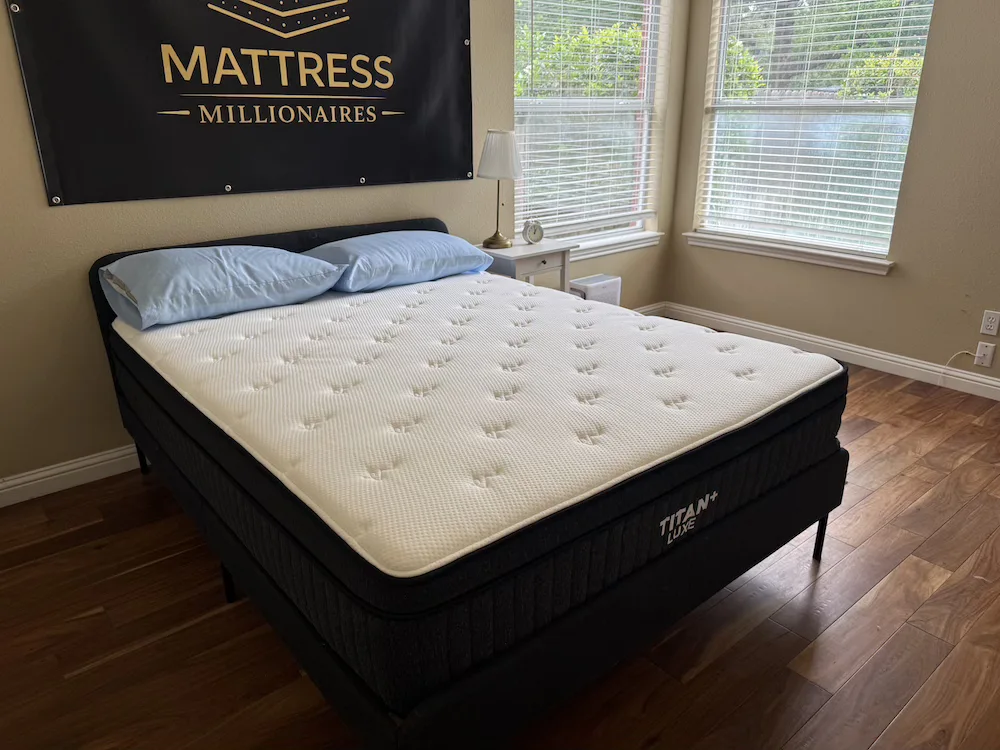
All photos in this review were taken during our real-world testing of the Titan Plus Luxe mattress (queen medium).
Mattress Millionaires Quick Verdict: Is Titan Plus Good for 250+ lb Sleepers?
Our take: Titan Plus deserves a place on your shortlist if you want a firm mattress, particularly for back or stomach sleeping. Side sleepers should compare it carefully with the Titan Plus Luxe before deciding.
When shopping for a mattress for a bigger body, one of the most important factors to consider is whether the mattress supports your body comfortably through the night. A bed that barely compresses can still be uncomfortable, and a cushioned surface can still have substantial support underneath.
Here is how we would approach the decision:
| Your sleep needs | Our buying recommendation |
|---|---|
| Back sleeper who dislikes deep sinkage | Put the Core on your shortlist; check how your lower back feels overnight. |
| Stomach sleeper whose hips sink too far | Consider the Core, with particular attention to pelvic support. |
| Side sleeper with sensitive shoulders or hips | Compare the Luxe before choosing the Core. |
| Couple with very different comfort preferences | Test both partners’ positions; consider split firmness if needed. |
| Shopper expecting a guaranteed back-pain solution | Judge comfort individually; no mattress is a universal treatment. |
These are suitability judgments, not measured performance scores from a 250+ pound Core tester. Also, one naming detail matters: the standard Titan Plus is currently sold as the Titan Plus Core. This article focuses on that model. Our separate hands-on Titan review covers the Plus Luxe; those testing results should not be treated as Core results. The recommendations here combine current manufacturer information, published research, and our assessment of what to prioritize when shopping.
What Makes Titan Plus Good for Heavier Sleepers?
Titan positions the Core as its firm option for plus-size sleepers. Its published construction includes a quilted gel-foam top, TitanFlex foam, an eight-inch individually encased coil unit, and a thin base layer. An optional GlacioTex cooling cover is available.
Our interest is in how those parts work together. When shopping, we want enough surface cushioning to feel comfortable and enough underlying resistance to keep the middle of the body from sinking excessively.
We would also look beyond a coil count. It does not tell you how a particular sleeper will feel, whether the edge will be comfortable for putting on shoes, or how the upholstery will change after years of use.
A construction diagram helps explain a mattress. Your overnight experience determines whether it fits.
Why 250 Pounds Is a Starting Point, Not a Firmness Prescription
Two people who weigh 275 pounds may want very different beds. Height, body shape, preferred position, and where someone carries their weight all influence the experience.
Picture a tall back sleeper who wants very little cushioning, then a shorter side sleeper who needs room for the shoulder and hip to settle. Giving both people the same recommendation simply because they cross the same weight threshold misses the point.
We would begin with three questions:
- Where does your current mattress feel uncomfortable?
- Do you feel stuck in a dip, or perched on a surface that barely gives?
- Which position do you actually spend most of the night in?
Your answers are more useful than choosing the highest firmness number available. They also help you avoid solving the wrong problem: replacing an overly soft mattress with one that creates a different kind of discomfort.
Is Titan Plus Good for Back Sleepers Over 250 Pounds?
For back sleepers, our priority would be a comfortable, stable resting position without a pronounced dip beneath the pelvis.
The Core is worth considering if that dip is what you dislike about your current bed. During a trial, pay attention to whether you can relax naturally or keep shifting to make your lower back comfortable.
We would track morning comfort alongside the first impression. Does your back feel better, worse, or unchanged when you get up? Does any initial comfort last through the night?
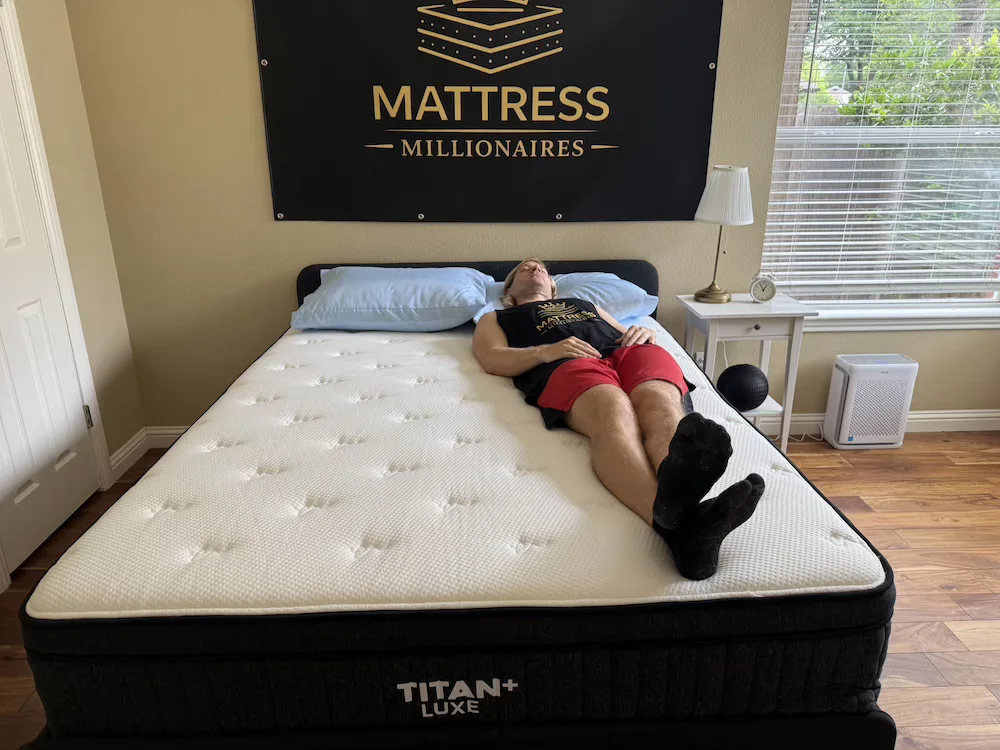
Pillows also deserve attention. Mayo Clinic suggests that back sleepers try a pillow beneath the knees to help relax the back muscles and maintain the lower back’s curve. Its guide to sleeping positions that reduce back pain also addresses neck support.
That is a useful reminder to evaluate the whole setup. You do not want an unsuitable pillow to confuse your assessment of a new mattress.
What About Stomach Sleepers?
If you sleep on your stomach, pay particular attention to how far your pelvis settles compared with your chest. Our concern would be a position that feels increasingly uncomfortable as you lie there.
When testing, spend time in your normal position instead of judging the bed while sitting upright. Notice whether you can settle comfortably without bracing your muscles or repeatedly repositioning a leg.
A firm feel alone does not resolve every issue associated with stomach sleeping. Mayo Clinic notes that this position can strain the back and suggests trying another position when possible. If stomach sleeping is unavoidable, a pillow under the hips and lower abdomen may help reduce strain. See its stomach-sleeping guidance.
Our recommendation is conditional: consider the Core if you prefer firm support, but judge the result by comfort through the night.
Is Titan Plus Too Firm for Heavier Side Sleepers?
This is where we would be more selective.
Side sleeping asks a mattress to accommodate the shoulder and hip while supporting the space between them. Being heavier does not remove the need for cushioning at those contact points.
During a trial, notice whether you keep rolling away from the same shoulder or hip. We would treat repeated discomfort as useful feedback, rather than assuming you simply need to get used to a firmer bed.
If you are concerned that you need more cushioning, compare the Titan Plus with our full review of the Titan Plus Luxe. Titan positions it for plus-size side sleepers, with additional cushioning compared with the Core.
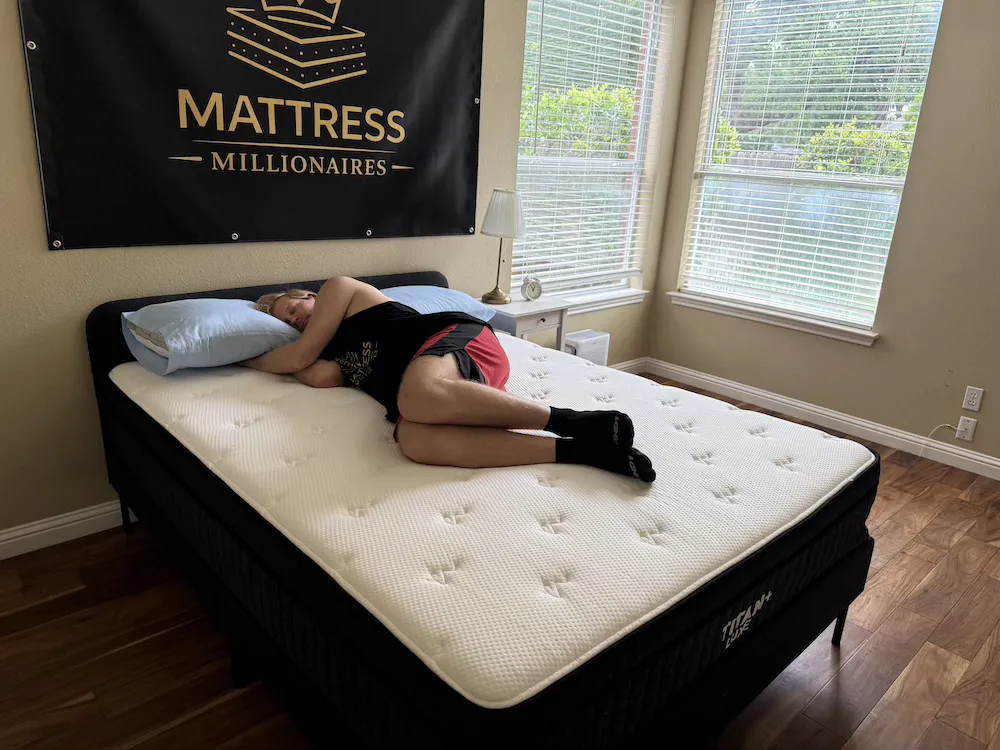
Our view is that this makes the Luxe a more logical starting point for someone whose main complaint is pressure at the shoulder or hip. That is a reason to compare models, not a guarantee that the Luxe will suit every side sleeper.
For a closer look at the comfort issue, read our guide to what pressure relief means in a mattress.
Does Research Support Buying a Firmer Mattress?
Research supports being more thoughtful than “harder is better.”
A randomized trial published in The Lancet studied 313 adults with chronic nonspecific low-back pain. Over 90 days, the medium-firm mattress group had better outcomes on several pain and disability measures than the firm mattress group. The study is indexed by the National Library of Medicine.
That does not establish the best Titan model for a 250+ pound sleeper. The trial did not test Titan mattresses, and its firmness measurements should not be equated directly with a brand’s retail rating.
Harvard Health also cautions against assuming that very hard mattresses are best. It discusses evidence linking very hard beds with poorer sleep among people with low-back pain, while explaining that excessive sinking in a soft bed can also be problematic. Its mattress guidance for people with low-back pain emphasizes finding a comfortable fit.
Our takeaway: choose enough support to feel stable and enough cushioning to stay comfortable. Neither extreme earns extra credit.
Edge Support: Test Sitting and Lying Down Separately
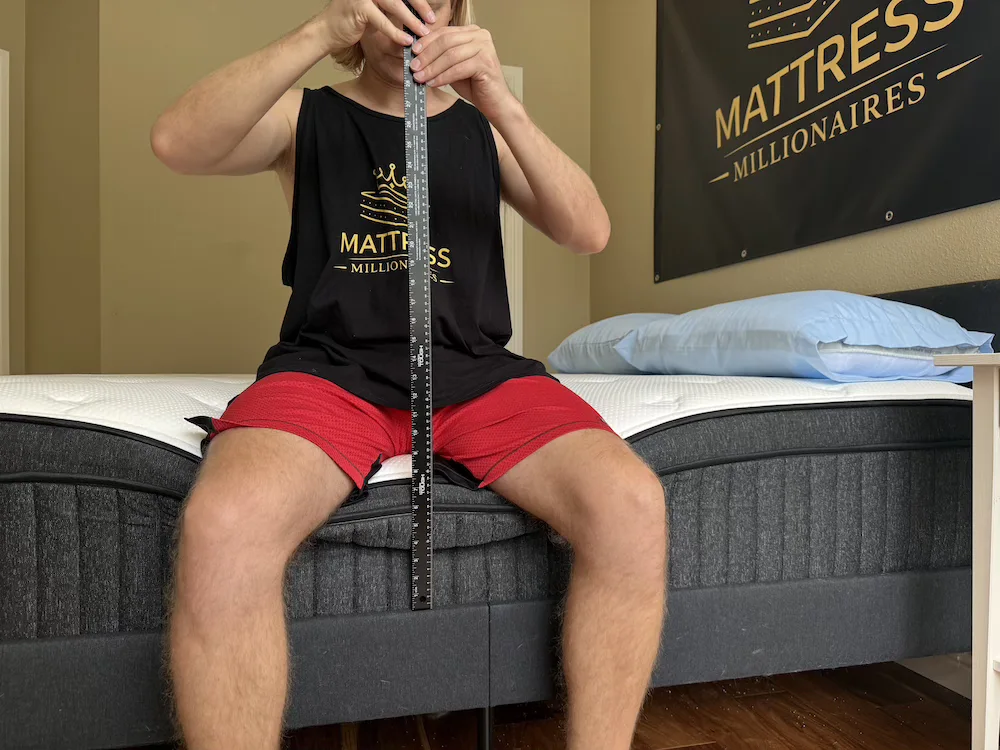
We would make edge testing a priority if you sleep with a partner, use the full width of the bed, or sit on the side while getting dressed.
Try two separate checks:
- Lie near the edge in your usual position. Do you feel secure, or move inward because the perimeter feels unstable?
- Sit where you normally get in and out. Can you rise comfortably without feeling that you are sliding forward?
These are different uses, so one should not substitute for the other. A comfortable sleeping edge does not automatically mean a rigid seated edge.
We would avoid assigning the Core an edge-support score without direct testing under the relevant body weight. Make this a specific trial-period check instead of relying on a broad “reinforced support” description.
What Couples Should Check
A shared mattress needs to work for two people, and weight is only one part of that equation.
Have each partner test their normal position while the other turns over, gets up, and returns to bed. Notice actual disturbance, not simply whether movement is visible.
Then compare comfort independently. One partner may like the amount of give while the other wants more cushioning. Neither person’s experience cancels out the other’s.
We would not buy a shared mattress based only on the heavier partner’s requirements. Both people need comfortable support. If preferences are far apart, a split-firmness setup may be more practical than repeatedly compromising on one uniform surface.
Will It Sleep Cool?
We would treat cooling as something to verify in your bedroom, especially before paying for an upgrade.
The useful questions are practical: Do you wake feeling hot? Does warmth build beneath your torso? Are you throwing off the covers even when the room feels comfortable?
Keep your usual sheets and bedding consistent while assessing the mattress. Changing the comforter, protector, room temperature, and bed at once makes it harder to know what helped.
A cool first touch is pleasant, but we would base the buying decision on how the complete setup feels several hours later. Without overnight temperature data for your circumstances, a cooling feature remains a feature to assess rather than a promised outcome.
Durability and Weight Capacity: What to Verify
Before ordering, ask the manufacturer for the current weight guidance for your exact model and size. Clarify whether the number describes total mattress capacity or a per-person recommendation.
Then check the frame separately. Its rating may include the mattress itself, both sleepers, and bedding. Confirm the foundation and center-support requirements in the current warranty terms.
We would also ask what counts as a covered indentation and how it must be measured. A warranty’s length does not tell you whether every change in comfort qualifies for a replacement.
Keep your order details and photograph the initial setup. These are simple steps that make later questions easier to resolve.
How We Would Use the Sleep Trial
A short daily note is more useful than trying to remember how the mattress felt several weeks ago.
Record your main sleep position, morning comfort, nighttime awakenings, and any recurring shoulder or hip discomfort. If sharing the bed, have both partners keep separate notes.
Look for a pattern: is comfort improving, staying the same, or getting worse? Avoid treating a single unusually good or bad night as the final answer.
Before purchase, read the minimum trial requirement, return deadline, fees, and collection process. Persistent or worsening pain deserves medical advice; it should not be dismissed as an obligatory mattress adjustment period.
Mattress Millionaires Final Verdict: Is Titan Plus Good for 250+ lb Sleepers?
Titan Plus is a reasonable candidate for 250+ pound sleepers who prefer a firm bed. We would be more cautious for side sleepers whose biggest need is shoulder and hip cushioning.
Buy according to the problem you want to solve. Test your usual position, include your partner, and make the return terms part of the decision. The best choice is the mattress that supports you comfortably all night—not simply the one marketed to your weight category.
FAQs: Is Titan Plus Good for 250+ lb Sleepers?
Is Titan Plus suitable for someone who weighs 300 pounds?
It is worth considering, but 300 pounds alone does not establish suitability. Confirm the current capacity guidance, then evaluate your sleep position, comfort preferences, and foundation.
Should a heavier side sleeper choose Core or Luxe?
We would compare the Luxe first when shoulder and hip cushioning are priorities. Choose based on overnight comfort rather than assuming every heavier sleeper needs the firmest model.
Can a topper fix a mattress that feels too firm?
A topper may change surface comfort, but we would first consider whether exchanging the mattress is more sensible. Adding another purchase should be a deliberate choice, especially during an active return window.
Will Titan Plus fix back pain?
No mattress can promise that. A better fit may improve sleeping comfort, but published firmness research does not prove that Titan treats back pain.
Ready To Sleep Better?
Take our quiz to find the mattress that fits your sleep style and budget.
"I found my perfect mattress in 60 seconds." - Sarah H., side sleeper
✅ Super fun! 🥳
⭐ Trusted by 10,000+ sleepers 😴
🛏 Personalized mattress match 💤